From Poland to Italy, the universality of a masterpiece
The world of Halka is one of the most universal stories in Moniuszko’s entire oeuvre. Every culture knows this figure: a woman wounded by love, marginalized by the social order, left alone with decisions that proved stronger than she was. The Italian version becomes a key here – not an end in itself – an opening of the score and emotions, through which subsequent performances, sung in Polish, can resonate more fully, purer, and more painfully. This is not a change in the work’s identity, but its unveiling. The Italian language allows us to momentarily set aside the burden of national habits and listen to music and relationships that do not require local identifying marks.
This staging does not seek to fix or modernise anything. The boundary between the imagined and the real world remains blurred, for it is precisely in this uncertainty that the opera’s meaning is born. We do not show a realistic village or ritual, but the energy of a community and its inertia. In this world, there is a reconciliation with the fate of his subjects, from which the only escape seemed to be death or madness. Jontek does not take revenge. Janusz does not pay for his sins. The highlanders continue to dance in the pastures, as if the tragedy were only a momentary break in the rhythm of life. This indifference is perhaps the cruelest. The community endures, the tragedy is pushed to the margins as an incident that should not disrupt the rhythm of life. It is this indifference that proves most brutal. Reconciliation with fate becomes the norm, and the only escape remains death or madness.
Jontek is therefore an antihero not from a lack of feeling, but from an excess of acceptance of his fate. And this question remains as relevant today as it did in Moniuszko’s time: does kindness without courage become a form of complicity?
Therefore, the idea arises to reverse historical obviousness and return the narrative to the spirit of Halka. She becomes the guide through this story, not as a victim, but as a consciousness that refuses to be silenced. Ghosts don’t forgive easily. Perhaps that’s why Halka remains painful for our audiences to this day. As if this voice were saying directly that any woman—including a modern, liberated, independent, educated one—can experience a love so intense that it destroys. Beyond social conventions, beyond stereotypes, beyond the rational arrangements of the world. And that, in this sense, Halka doesn’t belong to the 19th century or to a single country. It always happens when a feeling becomes stronger than the order that was supposed to protect it.
In this story, everything begins with an absence. We don’t recognize Halina. Halka bursts onto the stage—named, described, enclosed in a diagnosis. Wounded, struggling, touched by madness, as if the world saw in her only the effect, never the process. It’s a surprisingly un-operatic gesture: taking away the heroine’s path, leaving her only the consequences. As if a woman begins to exist only when she’s no longer comfortable. And here the question returns with full force today: isn’t the modern woman, fighting for her feelings and priorities, still perceived as irrational, excessive, and too intense? Halka no longer has a language of dialogue. Her language becomes extreme.
Madness so beloved by operatic convention. Moniuszko can, without inhibitions, compete with the genius of Donizetti and his mad Lucia, the final vision of the dying Violetta, or the stark realism of Janacek’s Jenufa.
That’s why, in this production, the narrative is taken over by ghosts. They change perspective. Halka’s spirit is no longer just the shadow of the victim, but a consciousness that guides us through history and refuses to let it be closed. Ghosts don’t forgive easily, because they remember what has been silenced. They reverse historical certainties, shattering the peace of those who have moved on. Perhaps that’s why Halka still hurts our audiences so much. As if this voice were clearly saying that every woman—including today’s liberated, independent, educated ones—can experience a love so intense that it destroys. Beyond social conventions, beyond stereotypes, beyond the rational order of the world. And we are still learning how to view this power not as madness, but as a truth we don’t want to hear.
Michał Znaniecki
Libretto – Włodzimierz Wolski
Libretto in Italian– Giuseppe Achille Bonoldi
Opera in 4 acts
DATES
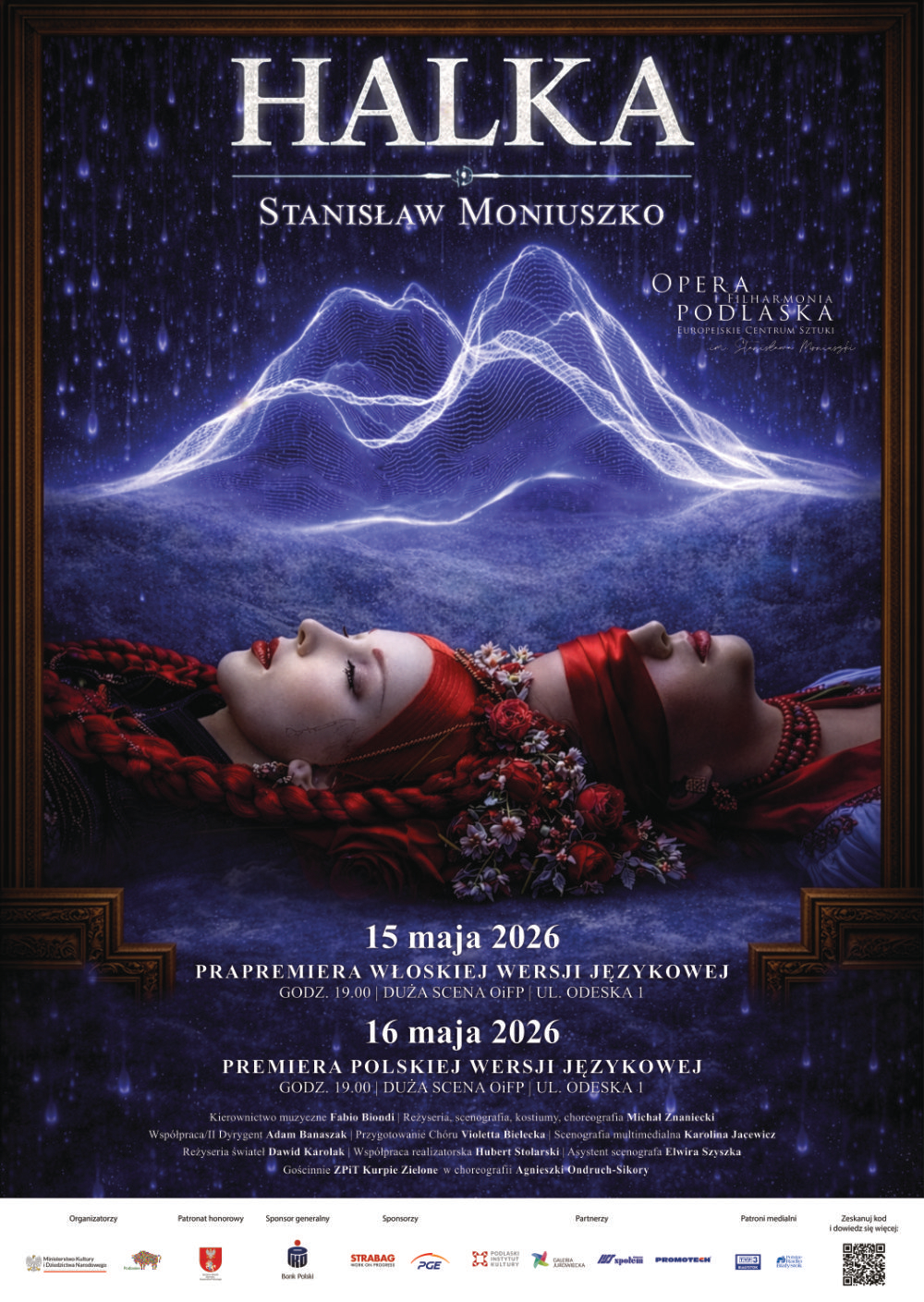
15.05.2026 7:00 PM – PREMIERE OF THE ITALIAN LANGUAGE VERSION (with Polish subtitles)
16.05.2026 7:00 PM – PREMIERE OF THE POLISH LANGUAGE VERSION
17.05.2026 6:00 PM – Italian language version (with Polish subtitles)
23.05.2026 7:00 PM – Polish language version
24.05.2026 6:00 PM – Polish language version
30.05.2026 7:00 PM – Polish language version
31.05.2026 6:00 PM – Polish language version
Halka is performed using materials from the Polskie Wydawnictwo Muzyczne.