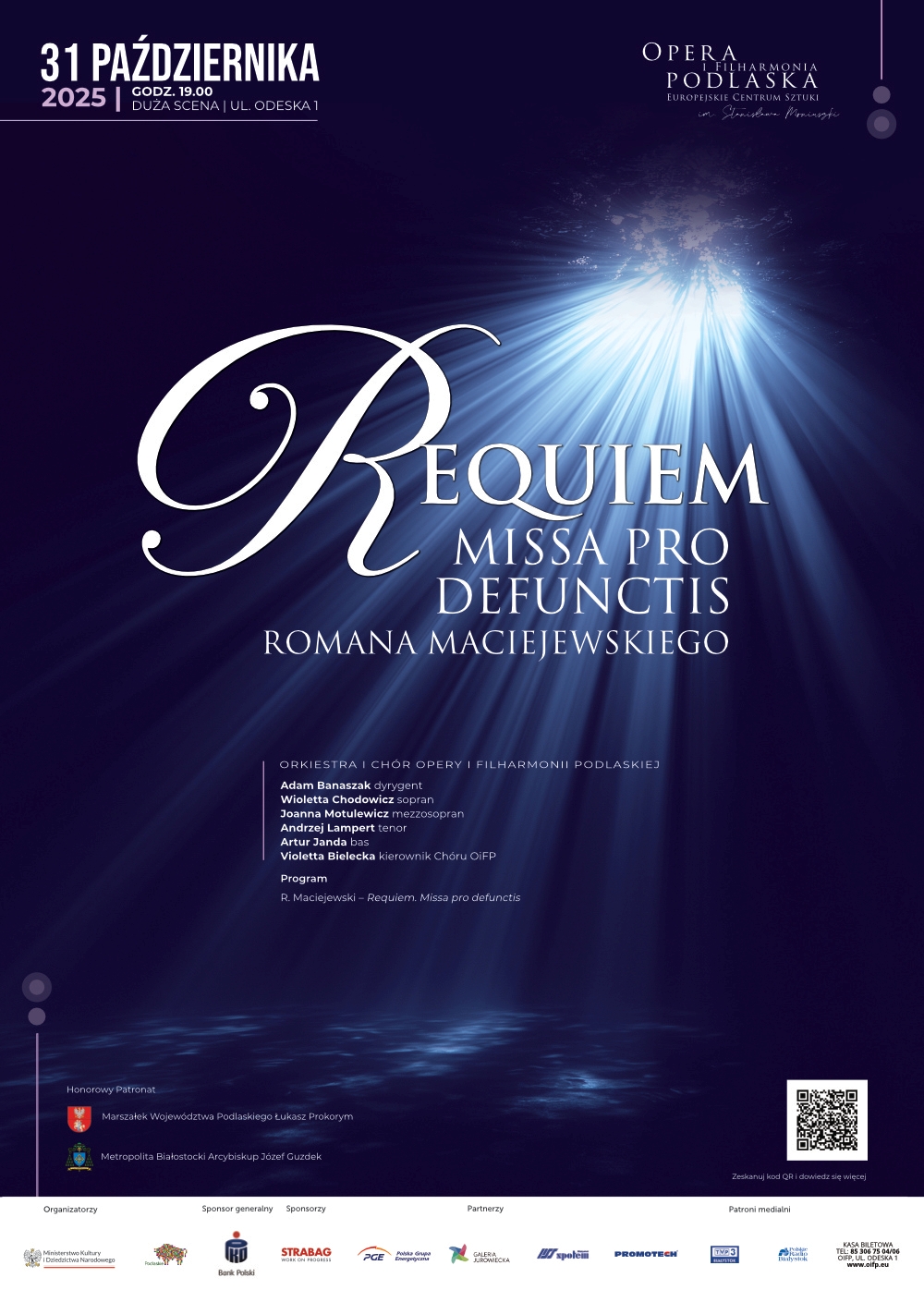
Concert under the Honorary Patronage of Łukasz Prokorym, Marshal of the Podlaskie Voivodeship, and Archbishop Józef Guzdek, Metropolitan of Białystok
On October 31st, we invite you to a special concert featuring R. Maciejewski’s Requiem: Missa pro defunctis. The composer dedicated this monumental work to ‘The victims of human ignorance, The victims of wars throughout history, The victims of tyrants’ torment, The victims of human lawlessness, The victims of the violation of the divine order of nature’.
The work premiered at the ‘Warsaw Autumn’ International Festival of Contemporary Music on September 20, 1960. Maciejewski worked on the Requiem for almost 15 years, writing it while he was suffering from a terminal illness, which he overcame after a complete change of lifestyle. The composer retreated to the Swedish forests, began practicing yoga and meditation, and sought connection with God.
Requiem: Missa pro defunctis is an exceptionally universal work, preserving traditional principles of composition, sound, and form. It is preceded by a motto, the words of Christ from the Gospel of Luke (23:34): Father, forget them, for they know not what they do.
The concert will feature outstanding soloists: Wioletta Chodowicz (soprano), Joanna Motulewicz (mezzo-soprano), Andrzej Lampert (tenor), Artur Janda (bass), and the Orchestra and Choir of the Podlasie Opera and Philharmonic, conducted by Maestro Adam Banaszak.
We invite you to join us!
Transience and Duration
“We won’t be able to deal with Hans Castorp’s story quickly. Not even seven days a week, not even seven months, will suffice. It’s best not to predetermine how long it will hold us in its bonds on earth. Surely, for God’s sake, it won’t last seven years!”
The words quoted above come from the introduction to Thomas Mann’s The Magic Mountain. Time itself becomes one of the novel’s characters, slowing, accelerating, and sometimes almost stopping the narrative and action. From a certain point on, we can’t tell how much time has passed, how much time lies ahead. I have a strong conviction that, in a similar way, Roman Maciejewski’s Requiem is a work whose themes and characters include time. On the one hand, I think of a composer who writes his work over nearly fifteen years. He does this deliberately, after all, we know enough examples from the history of music to prove that it is possible to write a work of this magnitude in a much shorter time. This deliberate spacing of the compositional process was intended to give Maciejewski the opportunity to organically integrate his composition into the rhythm of life, harmony with nature, prayer, and meditation. On the other hand, I also think about the piece itself, which lasts approximately two hours and fifteen minutes. It presents a perceptual challenge for both listeners and performers. However, at the end, a unique reward awaits – the possibility of catharsis, catharsis, and peace.
This monumental piece is in matter of fact unfinished! Over the course of more than a decade, the first five parts of the Mass for the Dead were composed: Introit, Kyrie, Graduale, Tractus, and Dies irae. The Domine Jesu, Hostias, Sanctus, Benedictus, and Agnus Dei are missing… How long would it take to perform then? How long would it take to compose it in such a case? Thinking about this issue in this way, we see that Roman Maciejewski’s Requiem is open to eternity, perpetuity and the moment foreseen in the Apocalypse when “time will be no more.”
After all, what are 135 minutes compared to eternity? In this composition, time has another aspect – therapeutic. Cleansing, psychotherapy, and healing require time. Just like meditation and prayer. These are not disciplines for the busy and impatient. Maciejewski’s Requiem similarly requires time to impact its listeners on a biological level, but also on a metaphysical one – it is music that, instead of “passing away,” chooses “lasting.”
Roman Maciejewski studied under Nadia Boulanger. They knew and valued him: Igor Strawiński, Francis Poulenc, Ingmar Bergman, Karol Szymanowski, Czesław Miłosz, Artur Rubinstein… Born in Berlin, originally from Leszno and educated in Poznań, he emigrated to the United States and Sweden. His extensive travels around the world have sought solitude in the backwoods and deserts. He founded and led distinguished choirs, turning down lucrative offers from Hollywood. While struggling with illness, he began practicing yoga, praying, and meditating until his symptoms subsided. His life story is a ready-made script for a film or a multi-episode televisionn series!
Writing Requiem, Roman Maciejewski was not only creating his opus magnum, but above all, he wanted to thank the Creator for his health restored after a seemingly incurable illness. He also wanted to come to terms with the horrors of World War II. The dedication on the first page of the score is categorical: ‘To the victims of human ignorance, To the victims of wars of all time, To the victims of tyrants’ torment, To the victims of human lawlessness, To the victims of the violation of the Divine order of nature’. The whole is preceded by a motto – the words of Christ spoken on the Cross (Lk 23:24): ‘Father, forgive them, for they know not what they do’.
Of course, we have many versions of Missa pro defunctis – with compositions by Wolfgang Amadeus Mozart, Giuseppe Verdi, Gabirel Fauré, Benjamin Britten and Krzysztof Penderecki among the most prominent. However, Maciejewski’s composition has no parallel in the history of music. So what is this work like?
To quote the composer, ‘a few rays of light from this land where there is no time or space’. Maciejewski wanted “a bridge between the ancient past and the present.” His work was intended to be understandable, accessible, and inclusive – for people to listen to! And at the same time, simple, bringing reconciliation and peace. The composer wrote it in harmony with the surrounding world – in a rhythm combined with meditation and prayer, but also with nature. This is very Franciscan in spirit! Maciejewski complemented it with his fascination with hatha yoga. Giving voice to the composer: ‘I try to live so that my art proves that even in our times, man can live in harmony with himself, with others, and with God’.
The Requiem, therefore, stems from nature, is united with nature, and in a sense, we can say it is a holistic work. The work was written entirely in the major-minor scale. It’s no wonder the premiere at the avant-garde Warsaw Autumn Festival in 1960 was met with little enthusiasm. For the composer, major-minor represents a natural order: ‘I have never departed from the natural laws of acoustics: from sound with its entire structure. I base my work on a diatonic triad at the bottom, which, as it moves upwards, becomes increasingly chromatized […]’. So we have – as the composer’s method of operation – a pure bass foundation, in harmony with nature. Diatonically at the bottom, chromatically at the top – exactly as in the series of overtones, tones that make up each sound. The way the piece is written is meant to reflect the philosophy of music – a certain tribute to what music is composed of, its physical and acoustic principles! But the premise is also a long and calm, yogic breath, which translates into the shaping of phrases and melodies. The composer’s goal was not to depict the nightmare of war, but to provide solace, mental relaxation, liberation from tension, a deeper breath. In this understanding, the work is not only a contemplation of death, but equally a hope for life.
Or perhaps it’s simply an eclectic, understandable, and accessible work, with a triple, expansive, and monumental fugue (Kyrie) rigorously written in polyphony and counterpoint! These seem impossible assumptions! Yet the composer melds it all into a single whole in an extraordinary way, adding Gregorian chant, Baroque form, psalmody, a procession, a funeral procession, as well as inspirations from French music (Francis Poulenc!) and film. Treated as a painting, Dies Irae offers a vision presented through music that is most clearly programmatic and rhetorical. The Danse Macabre is depicted here in an unambiguous manner. But the division between heaven, hell, and earth is equally clear. Light—rendered musically from the very first bars—and its transformations become a separate theme! A vast performing apparatus: choir, orchestra (with quadruple woodwinds, celesta, harps, two pianos, and organ), and a quartet of soloists. The instrumentation is unusual and reminds me of the organ’s way of thinking about switching on and off subsequent voices.
I’m writing these words down in Leszno, Greater Poland, where the composer and his family came from. I’m sitting in his symbolic study, recreated in the Municipal Library. In a moment, I’ll walk to the Market Square and examine the plaque on the house where he lived. Finally, at the municipal cemetery, I’ll light a candle at the composer’s grave, a few dozen meters from my family’s grave.
If, on the eve of the day when, according to ancient tradition, we bow to the shadows of our loved ones, we seek solace, reflection, hope, but also cleansing and forgiveness, it seems to me that we can find them precisely in this music. “A ray of light from a land without time and space.” This is what I will be thinking about as I raise the baton tonight.
Adam Banaszak
ADAM BANASZAK
Music Director of Musicae Antiquae Collegium Varsoviense – the Early Music Orchestra of the Warsaw Chamber Opera (since in the 2023/2024 season) From 2019 to 2024 he was Music Director of the Wrocław Opera and in the 2021/2022 season, Artistic Director of the Grand Theatre in Łódź. Opera is his most important area of conductor’s activity. He has conducted over 600 concerts and performances, and he was the musical director or collaborated on the preparation of over 50 premieres. He has conducted prefromances such as: The Barber of Seville, Cinderella by G. Rossini, The Elixir of Love by G. Donizetti, La Traviata, Rigoletto, Nabucco, Don Carlos by G. Verdi, Madame Butterfly, La Boheme, Tosca by G. Puccini, P. Mascagni’s Cavalleria rusticana, I Pagliacci R. Leoncavall, Eugene Onegin by P. Tchaikovsky, S. Moniuszko’s Halka, Faust by Ch. Gounod, Carmen by G. Bizet. His collaboration with ensembles playing historical instruments has resulted in performances of Monteverdi’s Orfeo, Handel’s Julius Caesar and Messiah, Telemann’s Brockes Passion, Haydn’s The Creation, and Mozart’s operas. The music of W.A. Mozart has accompanied him in a special way throughout his artistic career. He conducted the premieres of Cosi fan tutte, The Marriage of Figaro, The Magic Flute. He has also conducted numerous Mozart symphonies, piano and violin concertos, sacred works and performances of the so-called Mozart trilogy – Da Ponte. He recorded the composer’s Requiem, which was very well received by critics, for the DUX label with the Warsaw Chamber Opera ensembles. Contemporary music complements the conductor’s wide repertoire. He premiered operas by P. Mykietyn (The Magic Mountain) and Z. Krauze (Yemaya – Queen of the Seas). He also frequently performed less frequently performed works (L. Bernstein’s Trouble in Tahiti, F. Poulenc’s The Human Voice). He recorded Curlew River and The Burning Fiery Furnace B. Britten. He had conducted preformances at the Warsaw Chamber Opera, the Wrocław Opera, The Grand Theatre in Łódź, TW-ON, The Baltic Opera in Gdańsk, the Cracow Opera, the Silesian Opera in Bytom, the OiFP, the Nova Opera in Bydgoszcz, the Castle Opera in Szczecin. He regulary collaborate with philharmonic ensembles (Poznań, Łódź, Kraków, Szczecin), he also serves as the first guest conductor of the Toruń Symphony Orchestra. His concerts and performances have been rebroadcast by Rundfunk Berlin-Brandenburg, Polish Radio Channel Two, TVP Kultura, Radio Poznań and others. He has recorded with the Polish Radio Orchestra and the Beethoven Academy Orchestra. He is an assistant profesor at the Academy of Music in Wrocław with a postdoctoral degree. As an opera promoter on Radio 2, he hosted, together with A. Kwiecińska, a series of programs on the music of G. Puccini and J. Strauss. He also co-creates the podcast Anatomy of an Opera for Polish Radio. The conductor always returns with joy to the OiFP, with which he has collaborated since 2014 (J. Bock’s Fiddler on the Roof, W.A. Mozart’s The Magic Flute, J. Strauss’s Die Fledermaus, and The Books of the Magic Flute).
WIOLETTA CHODOROWICZ
She is a graduate at the Wrocław Academy of Music in the class of Professor A. Młynarska. She made her debut in 2002 on the stage of the Grand Theatre in Poznań as the Countess in W.A. Mozart’s The Marriage of Figaro, and her subsequent roles on that stage included Donna Elvira in W.A. Mozart’s Don Giovanni and Bogna in F. Nowowiejski’s Legend of the Baltic Sea. From 2003 to 2008 as a soloist at the Wrocław Opera, she sang on that stage main opera parts, among others, Pamina in The Magic flute and Fiodiliga in Cosi fan tutte by W. A. Mozart, Mimi in G. Puccini’s La Boheme, the title role of Halka in the opera by S. Moniuszko, Agatha in Der Freischutz by C.M. von Weber, the title role Hagith in K. Szymanowski opera, Helmwige in Valkirie by R. Wagner. Since 2004 she is also associated with the TW-ON, where she made her name as Halka in S. Moniuszko’s opera, Donna Anna in Don Giovanni and the Countess in The Marriage of Figaro by W.A. Mozart, Marie in Wozzeck by A. Berg, the title role of Katia Kabanova in L. Janaček’s opera, Marta in The Passenger by M. Weinberg and Balladyna in Goplana by W. Żeleński. In OiFP she debuted title part in Turandot opera. In 2021 she joined to the OiFP soloist ensemble, she performedas Ligia in Quo vadis by F. Nowowiejski, Mimi in G. Puccini’s La Boheme, Santuzzo in I Pagliacci/ Cavalleria rusticana by R. Leoncavall/ P. Mascagni. She performed on european theatre stages, among others, Národnı́ divadlo Praha (Tatiana in Eugene Onegin by P.Tchaikovsky and the title Rusalka (a water nymph) by A. Dvořák), Národnı́ divadlo moravskoslezské Ostrava (Katia Kabanova L. Janáčka), Welsh National Opera Cardiff (Marie in Wozzeck by A. Berga), Glyndebourne Opera (Rusalka), she also appeared on stage Israeli Opera in Tel Awiwie (Cio-Cio-San in Madame Butterfly by G. Puccini). In the years 2015-2018 she was soloist at the Cracow Opera, where she created the title roles: Butterfly, the Countess in The Marriage of Figaro, Micaeli in Carmen and Elisabeth in Tannhäuser. She sang main sopran parts in the concert’s preformances of Maria by R. Statkowski, Giovanna d’Aro by G. Verdi, Zamek na Czorsztynie by K. Krupiński, Requiem by G. Fauré, Symphony No. 9 and Missa solemnis by L. van Beethoven, Te Deum by A. Bruckner, Reqiuem by G. Verdi, Symphony No. 3 ‘Song of the Night’ by K. Szymanowski, Symphony No. 3 ‘Sorrowful Songs’ by M. Górecki, The Last Supper and Symphonies No. 2 and 8 by G. Mahler, and the Last Supper by R. Strauss, as well as in works by K. Penderecki: Polish Requiem, Te Deum, Strophes, and Songs of Reverie and Nostalgia. The artist has made numerous recordings: Giovanna d’Arco by G. Verdi, Maria by R. Statkowski, Quo vadis by F. Nowowiejski, Hagith by K. Szymanowski, Manru by I.J. Paderewski, and Hagith by K. Szymanowski. She is the recipient of the “Polityka” Passport for her performance in the opera Katia Kabanova (2010). In 2023, she performed the role of Amelia in Un ballo in maschera by G. Verdi on the stage of the Silesian Opera.
JOANNA MOTULEWICZ
She graduated from the Vocal Faculty of the Fryderyk Chopin University of Music in Warsaw, in the solo singing class of Professor J. Janucik. From 2012 to 2015, she participated in the Opera Academy of the Teatr Wielki – Polish National Opera in Warsaw. Since 2004 collaborates with Early Music Ensemble La Tempesta under the direction of J. Burzyński with whom she regularly gives concerts in Poland and Europe, and with whom she recorded a series of albums called Jasna Góra Early Music. Since January 2012 she is a soloist of the Podlasie Opera and Philharmonic in Białystok. On the stage of Podlasie Opera she preforming in productions: G. Bizet’s Carmen (title part), The Haunted Manor by S. Moniuszko (Jadwiga), G. Verdi’s La Traviata (Flora), Die Fledermaus by J. Strauss (Prince Orlofsky), W. A. Mozart’s The Magic flute (3rd Lady), The Gypsy Baron by J. Strauss (Mirabella), as well as in the musical Korczak by N. Stimson and C. Williams (Lucia) and as Fruma Sarah in Fiddler on the Roof by J. Bock. In June 2013 she started a collaboration with Classica Europa Opera in Frankfurt, whrer under the baton of H. Richter she preformed as Fenena in Nabucco by G. Verdi. Two years later she was involved to the Opera in Frankfurt and in theatre where she made her debut Bronka’s part in the opera The Passenger by M. Weinberg. In the next seasons she appeared in the staging of Triptych by G. Puccini, The Adventures of the Cunning Little Vixen by L. Janáček, Penelope by G. Fauré. In 2015 she made her debut on the stage of The Teatr Wielki- National Opera in The Haunted Manor by S. Moniuszko, at the 2016/2017 season she preformed there in the opera Oniegin by P. Tchaikovsky, and next in G. Bizet’s Carmen. The 2017/2018 season brought her debut on the Theater an der Wien stage, where she played the role of Bronka in The Passenger. In that time she also started collaboration with Dramma per musica Baroque Opera Festival. In the following seasons, the artist appeared successively at the Baltic Opera, Oper Graz (Austria), Opera Bielefeld (Germany) and at the Grand Theatre in Poznań, where she also took part in a recording of K. Szymanowski’s Stabat Mater conducted by J. Kaspszyk. In the 2022/2023 season she made her debute on the stage of the Poznań Opera as Ježibaba in A. Dvořák’s Rusalka, and in the following season she returned to the theatre in Bielefeld to play Carmen. In the 2024/2025 season she made her debut on the stage of the Chamber Opera in Warsaw as Cornelia in G.F. Handel’s Giulio Cesare, and then returned to the Baltic Opera in Gdańsk to portray the title role of Carmen in G. Bizet’s opera. The artist has collaborated with many outstanding conductors, including J. Kaspszyk, R. Kluttig, O. Lyniv, J. Mallwitz, A. Yurkevych, K.L. Wilson, Ch. Gedschold, L. Hussain, Ł. Borowicz, J.M. Florêncio, P. Przytocki, M.J. Błaszczyk, J. Debus, M. Dondajewski, Ch. Campestrini, C. Grabowski, M. Klauza, J.A. Modeß, J. Maksymiuk, M. Nowakowski, J. Hrusa, T. Tokarczyk, H. Richter, T. Wicherek, J. Burzyński, A. Banaszak.
ANDRZEJ LAMPERT
Born in 1981 in Chorzów. Soloist of the Silesian Opera in Bytom. A graduate of the Faculty of Jazz and Popular Music at the Karol Szymanowski Academy of Music in Katowice (class of Prof. Dr. hab. Renata Danel) and with distinction from the Faculty of Vocal Performance and Acting at the Academy of Music in Cracow (class of Janusz Borowicz, assistant professor of 2nd degree). He is a scholarship holder of the Minister of Culture and Art. From 2011, he studied in Vienna with Prof. Helena Łazarska, under whose vocal tutelage he remained until 2022 and participated in her master classes numerous times in Salzburg, Klagenfurt, and Cracow. A laureate of competitions, including the 3rd Ignacy Jan Paderewski Vocal Competition in Bydgoszcz, the 15th Ady Sari International Vocal Art Competition in Nowy Sącz and the 15th International Imrich Godin Vocal Competition “Iuventus Canti” in Vráblach. In 2010, he made his debut as Alfred in Verdi’s La Traviata at the Silesian Opera in Bytom. In 2013, he played the role of Lensky in Eugene Onegin by P. Tchaikovsky, being already a soloist of the Cracow Opera, where he performed for the first time as Pinkerton (Madame Butterfly by G. Puccini), and then as: Nemorino (L’elisir d’amore by G. Donizetti), Barinkay (The Gypsy Baron by J. Strauss), Paris (The Beautiful Helena by J. Offenbach), Walther (Tannhäuser by R. Wagner), Don Narciso (The Turk in Italy by G. Rossini), Ernest (Don Pasquale by G. Donizetti), Riccardo Percy (Anna Bolena by G. Dionizetti) and Rydygier/Skald (Wanda by J. Wnuk-Nazarowa). He has also appeared in Polish operas as Nadir (G. Bizet’s The Pearl Fishers), Romeo (Ch. Gounod’s Romeo and Juliet), Ruggero (G. Puccini’s The Swallow), and the Shepherd (K. Szymanowski’s King Roger). In 2014, he was Alfred in the premiere and series of performances of La Traviata at the Montpellier National Opera, and a year later, he sang the role of Tamino in W.A. Mozart’s The Magic Flute at the Baden Opera House. He has also performed numerous concerts, including solo parts in the St. Matthew’s Passion (Vienna, 2014) and the St. John’s Passion (Salzburg, 2015). He also performed as Preisträger at the International Summer Academy of the Mozarteum University of Salzburg and at the Salzburger Festspiele (2013). He has received invitations to perform in operas and vocal-instrumental projects in Canada, the USA, Germany, Austria, the Netherlands, Sweden, Portugal, France, Slovakia, the Czech Republic, Ukraine, Estonia, Lithuania, and Greece. He has participated in numerous recordings, including the premiere of S. Moniuszko’s opera Paria with the Choir and Orchestra of the Szczecin Castle Opera, G. Rossini’s Petite messe solennelle with the National Philharmonic, K. Szymanowski’s Symphony No. 3 with the National Polish Radio Symphony Orchestra, S. Moniuszko’s Masses (D minor, E-flat major, D-flat major) with the Polish Radio Symphony Orchestra, and Krzysztof Herdzin’s Requiem with the Polish Radio Symphony Orchestra and the National Philharmonic Choir. In 2020, he received the Fryderyk Award as soloist (alongside Wioletta Chodowicz, Ryszard Minkiewicz, Dariusz Maciej, and Łukasz Rosiak) for his album Karol Szymanowski: Hagith with the Polish Radio Orchestra under the direction of Director Michał Klauza. In 2017, he won the 11th Jan Kiepura Theatre Music Awards in the “Best Opera Singer” category. In 2018, he received the Zbigniew Gruca Award from “Dziennik Teatralny” and the “Golden Mask” for his vocal and acting role as Romeo in C. Gounod’s opera Romeo and Juliet at the Silesian Opera. In 2020 (alongside Placido Domingo), he received the Austrian Music Award in Salzburg in the “Best Young Talent” category for his role as the Shepherd in K. Szymanowski’s opera King Roger, performed at the Graz Opera House. In 2025, he was awarded the Silver Medal for Merit to Culture – Gloria Artis. In concert and recording projects, including those for Polish Radio and Television, he has collaborated with numerous popular music artists, most notably with the band PIN, which he co-founded from the beginning (along with Aleksander Woźniak and Sebastian Kowol). In a duet with Sarah Brightman, he recorded the song I Will Be with You, which was released on the European edition of the album Symphony. He is a winner of Elżbieta Skrętkowska’s popular television program Szansa na sukces, a popular 1990s program. He also performed the theme song for the TVN series Niania. He also recorded a version of the song Route 66 for the Polish version of the animated film Cars. In a duet with Hania Stach, he recorded the songs – Moja muzyka to ty (My Music is You) and Masz w sobie życia (You Have Faith in You) as the soundtrack to the High School Musical films in the Polish language version, and also dubbed the character of Troy Bolton in that production.
ARTUR JANDA
Bass-baritone, pianist. A graduate of the Warsaw Academy of Music in the singing class of Professor A. Radziejewska and the piano class of Professor K. Gierżod, he has been a soloist with the Warsaw Chamber Opera since 2008, performing in dozens of operatic roles. In 2011, he made his debut at the National Theater Mannheim in the roles of Un Passante and Un Poliziotto in the premiere of S. Sciarrino’s Superflumina.
As Il Malaspina in Luci mie traditrici by S. Sciarrino, he appeared at the ‘Warsaw Autumn’ festival (2016) and the ‘NODO’ festival in Ostrava (2018). Since November 2016, he has been collaborating with the Warsaw Chamber Opera, singing the roles of Zbigniew in S. Moniuszko’s The Haunted Manor, Escamillo in G. Bizet’s Carmen, and Don Alfonso in W.A.Mozart’s Cosi fan tutte and The Commander of the Guard in P. Hindemith’s Cardillac. He also appears as a guest at the Reiseopera in Enschede (Netherlands), the Wrocław Opera, the Kraków Opera, the Opera Nova in Bydgoszcz, the Baltic Opera in Gdańsk, the Grand Theatre in Łódź, and the Polish Royal Opera. In 2022, he made his debut at the prestigious Golden Hall of the Musikverein in Vienna. A year later, he sang the role of Escamillo in Bizet’s Carmen at the Opera National de Chile. In 2025, he appeared at the Teatro San Carlo in Naples in R. Strauss’s Salome. The artist also has an extensive oratorio repertoire, including major works by J.S. Bach, G.F. Handel, J. Haydn, W.A. Mozart, Dvořák, F. Liszt, G. Rossini, G. Fauré, W. Kilar, and K. Penderecki. The soloist is a three-time winner of the Fryderyk Phonographic Award. In 2019, 2020, 2022, and 2023, he was nominated for the Jan Kiepura Theatre Music Award in the Best Opera Singer category. In 2020, he was awarded the Silver Cross of Merit by the President of the Republic of Poland.
VIOLETTA BIELECKA
Conductor and Artistic Director of the Podlasie Opera and Philharmonic Choir in Białystok. From December 1, 2020, she served as acting director of the Podlasie Opera and Philharmonic, and on November 3, 2021, she was appointed director of this institution. She graduated with honors from the State Higher School of Music in Warsaw (major in choral conducting under Professor J. Bok and Professor R. Zimak). She is a graduate and former faculty member of the Postgraduate Studies in Choirmastering and Voice Production at the F. Nowowiejski Academy of Music in Bydgoszcz. In 2000, she received the title of Professor of Musical Arts from the President of the Republic of Poland. The choirs included the Białystok University of Technology Choir, the Schola Cantorum Bialostociensis Women’s Choir, and the Białystok Chamber Choir Cantica Cantamus, which has won numerous prestigious awards and distinctions. He was the initiator and organizer of the International Workshops for Polish Youth and the Polish Diaspora of the Polish Peace Philharmonic. She has collaborated with the Grand Theatre – National Opera in Warsaw as a vocal consultant to the choir. She is a professor at the Fryderyk Chopin University of Music, Białystok Branch. Since 2017, until 2024, she has been the head of the Department of Choral Conducting and Artistic Education at the Fryderyk Chopin University of Music in the Faculty of Instrumental-Pedagogical Studies, Music Education and Vocal Studies (1999–2005 head of the Department of Choral Conducting; 2005–2012 Vice-Dean of the Faculty, and from 2019–2024 member of the University Council, the Scientific Council, and the Artistic Discipline Council of the Fryderyk Chopin University of Music). She has trained numerous choirmasters, choral vocalists, and solo singers. Since 2006, she has served as the conductor and artistic director of the OiFP Choir, with whom they participate in prestigious international festivals, serving as musical literature in major concert halls. She has prepared the ensemble for concerts, radio and radio broadcasts, and CD recordings worldwide as part of major festivals (including Chopin and His Europe, the Ludwig van Beethoven Easter Festival, and Warsaw Autumn). Her artistic achievements include publishing phonographic works of vocal and instrumental works, operas, cantatas, and a cappella choral music, performed both domestically and internationally. Recordings of the OiFP Choir have won Fryderyk Awards in 2008, 2009, 2016, 2017, 2022, 2023, and 2024, as well as the 2018 International Classical Music Award in the choral category (for F. Nowowiejski’s Quo Vadis). She is a member of the Phonographic Academy’s music distribution section, which includes the phonographic releases section and the selection of Fryderyk Award winners. She also participates in the organizational work of controlling the Marshal of the Podlaskie Voivodeship Awards in the fields of artistic creativity, the preservation and protection of culture, and scholarships for individuals recognized for their artistic creativity, the subordination of culture, and responsibilities over historical monuments. Professor Violetta Bielecka has once again been honored for her artistic functions and services to culture, receiving, among others, the J. Kiepura Theatre Music Award (2019), the Silver Medal for Merit to Culture Gloria Artis (2008), and the J. Kurczewski Award for outstanding achievements in the field of choral music and the promotion of Polish music (2013). At the initiative of His Magnificence Rector, Prof. K. Baran, in 2021 she was awarded the Gold Medal for Merit to Culture – Gloria Artis under the auspices of the Minister of Culture, National Heritage and Sport, Prof. P. Gliński. In 2025, for her outstanding contributions to popularizing Polish musical culture and for her achievements in creative work, the President of the Republic of Poland, A. Duda, awarded her the Knight’s Cross of the Order of Polonia Restituta.